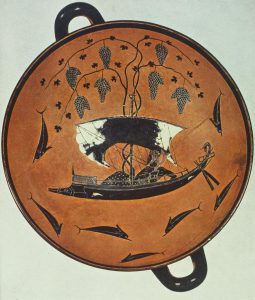
Dionysus crossing the sea. Exekias, 6th cent. B.C.
Karl Maurer, Former Chairman, Department of Classics, University of Dallas
The short answer is that in classical works we learn the ABC’s of our own tradition. The reason why nearly all words for the fields of activity are Latinized Greek is that Greeks and Romans actually invented ‘philosophy’, ‘politics’ and its main concepts, ‘epic’ and ‘lyric’, ’geography’, ‘geometry’, ‘mathematics’, ‘physics’, ‘biology’, and ‘astronomy’. To Greeks and Romans we really do owe ‘architecture’ and ‘sculpture’: not only the words but the thing itself: the circular amphitheater, the temple, the fluted column, the arch, and the dome, and the free-standing ‘statue’. Often a thing’s origins are hidden now; but every great medieval church, and even many a mosque, stole its basic form from the simple, immortally handsome Roman basilica.
It is better to be aware of these facts than oblivious. Today when few can read the ancient languages, we neglect the surviving texts, that even now could astonish and instruct. None of them can really be read in translation (for the reason, see Schopenhauer quoted below, his first two paragraphs). But by this coarse ignorance we lose not only the ancient texts themselves, but also a communion with our own ancestors, whose language and thought were steeped in the classical. And why does this matter? It does because Chesterton was not engaging in ‘hype’ but was simply right, when he said:
Tradition means giving votes to the most obscure of all classes, our ancestors. It is the democracy of the dead. Tradition refuses to submit to that arrogant oligarchy who merely happen to be walking around.
Such I think is the main reason for classical studies. But there are many; and into this little file I toss any pithy remark that I happen to encounter. I know that it will look very miscellaneous, but this has a certain charm. Of the authors here quoted only one (Jasper Griffin) was a professional classicist. There are poets, philosophers, and historians, a mathematician, a writer of detective novels, a pope, and a great doctor. I divide them into PROSE and VERSE and put them in the order of the authors’ birth dates.
PROSE:
- Arthur Schopenhauer(1788-1860): On the Study of Latin
- Gustav Seyffarth (1796-1885): Even the Stones Can Speak
- T. B. Macaulay(1800-1859): On the Greeks, especially Thucydides
- John Stuart Mill(1806-1873): On the Study of Classics
- James Russell Lowell(1819-1891): In Defense of the Study of Greek
- Friedrich Nietzsche(1844-1900): On Classical Philology & Slow Reading
- John William Mackail(1859-1945): On our Roman Inheritance.
- Alfred North Whitehead(1861-1947): On The Study of Latin
- Pope John XXIII(1881-1964): Promotion of the Study of Latin
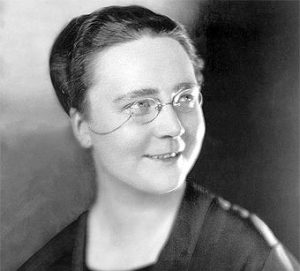
- Dorothy Sayers(1893-1957): Latin the Most Practical Subject
- Robert Graves(1895-1985) & Alan Hodge: On Bad (un-Roman) Writing
- Leo Strauss(1899-1974): On Classical Political Philosophy
- Eric Voegelin(1901-1985): On Reading Classical Works in the Original
- Lewis Thomas(1913-1993): How to Fix the Premed. Curriculum
- Jasper Griffin(1937-present): On a Classical Education
POEMS:
- Henri Estienne(1531-1598) To Thucydides
- Jacob Balde(1604-1668) To a Collector of Roman Coins
- Fyodor Tyutchev(1803-1873): On Cicero
- Alfred Tennyson(1809–1992) To Vergil
- Matthew Arnold(1822-1888) Apollo Musagetes
- Thomas Hardy(1840-1928) In The British Museum
- Osip Mandelstam(1891-1938) Rome. On Rome in Moscow. Tortoise.
- Louis MacNeice(1907-1963) on teaching classics
- Czeslaw Milosz(1911-2004) (on Herodotus and history)
- Lawrence Durrell(1912-1990) Nemea. Delos.
- Zbigniew Herbert(1924-1998): Why The Classics? (on Thucydides)
MISC:
- MISC. BRIEFER TESTIMONIALS about the Study of Classics
- NATIONAL TEST SCORES of Classics Students
* * *
* * *
Arthur Schopenhauer(1788-1860)
On the Study of Latin
Of all German philosophers, Schopenhauer is perhaps the one read most, and liked best, by non-philosophers (especially artists, musicians, and poets). One of the reasons is that he was subtly attentive to all people, not merely philosophers; and you can see this in the passage quoted here. It is from an essay in vol. II of his Parerga und Paralipomena (1851); English translation by T. Bailey Saunders in Complete Essays of Schopenhauer, New York, 1942, Vol. IV.
In learning a language, the chief difficulty consists in making acquaintance with every idea which it expresses, even though it should use words for which there in no exact equivalent in the mother tongue; and this often happens. In learning a new language a man has, as it were, to mark out in his mind the boundaries of quite new spheres of ideas, with the result that spheres of ideas arise where none were before. Thus he not only learns words, he gets ideas too.
This is nowhere so much the case as in learning ancient languages, for the differences they present in their mode of expression as compared with modern languages is greater than can be found amongst modern languages as compared with one another. This is shown by the fact that in translating into Latin, recourse must be had to quite other turns of phrase than are used in the original. The thought that is to be translated has to be melted down and recast; in other words, it must be analyzed and then recomposed. It is just this process which makes the study of the ancient languages contribute so much to the education of the mind.
It follows from this that a man’s thought varies according to the language in which he speaks. His ideas undergo a fresh modification, a different shading, as it were, in the study of every new language. Hence an acquaintance with many languages is not only of much indirect advantage, but it is also a direct means of mental culture, in that it corrects and matures ideas by giving prominence to their many-sided nature and their different varieties of meaning, as also that it increases dexterity of thought; for in the process of learning many languages, ideas become more and more independent of words. The ancient languages effect this to a greater degree than the modern, in virtue of the difference to which I have alluded.
From what I have said, it is obvious that to imitate the style of the ancients in their own language, which is so very much superior to ours in point of grammatical perfection, is the best way of preparing for a skillful and finished expression of thought in the mother-tongue. Nay, if a man wants to be a great writer, he must not omit to do this; just as, in the case of sculpture or painting, the student must educate himself by copying the great masterpieces of the past, before proceeding to original work. It is only by learning to write Latin that a man comes to treat diction as an art. The material in this art is language, which must therefore be handled with the greatest care and delicacy.
The result of such study is that a writer will pay keen attention to the meaning and value of words, their order and connection, their grammatical forms. He will learn how to weigh them with precision, and so become an expert in the use of that precious instrument which is meant not only to express valuable thought, but to preserve it as well. Further, he will learn to feel respect for the language in which he writes and thus be saved from any attempt to remodel it by arbitrary and capricious treatment. Without this schooling, a man’s writing may easily degenerate into mere chatter.
To be entirely ignorant of the Latin language is like being in a fine country on a misty day. The horizon is extremely limited. Nothing can be seen clearly except that which is quite close; a few steps beyond, everything is buried in obscurity. But the Latinist has a wide view, embracing modern times, the Middle Age and Antiquity; and his mental horizon is still further enlarged if he studies Greek or even Sanscrit.
If a man knows no Latin, he belongs to the vulgar, even though he be a great virtuoso on the electrical machine and have the base of hydrofluoric acid in his crucible.
There is no better recreation for the mind than the study of the ancient classics. Take any one of them into your hand, be it only for half an hour, and you will feel yourself refreshed, relieved, purified, ennobled, strengthened; just as if you had quenched your thirst at some pure spring. Is this the effect of the old language and its perfect expression, or is it the greatness of the minds whose works remain unharmed and unweakened by the lapse of a thousand years? Perhaps both together. But this I know. If the threatened calamity should ever come, and the ancient languages cease to be taught, a new literature shall arise, of such barbarous, shallow and worthless stuff as never was seen before.
* * *
* * *
Gustav Seyffarth (1796-1885)
EVEN THE STONES CAN SPEAK
Gustav Seyffarth (1796-1885) was a German archaeologist and Egyptologist, born at Uebigau, Saxony; he studied at Leipsig and in 1825 he became extraordinary professor of archaeology there; in 1855 he emigrated to the U.S. where he taught in the Lutheran Seminary at St. Louis; and from 1859 he lived in New York. Among his works are De Sonis Litterarum Graecarum (1824); RudimentaHieroglyphices (1826); Die Grundsätze der Mythologie und der alten Religionsgeschichte (1843); Untersuchungen über das GeburtsjahrChristi (1846); Grammatica Ægyptiaca (1855). I quote from his A Summary of Recent Discoveries in Biblical Chronology, Universal History, and Egyptian Archaeology (NY 1857; 2nd ed. 1859, p. 7-8).
The interest taken by the human mind in the monuments of antiquity is a remarkable phenomenon. Who does not regard with reverence an aged tree, which a thousand years ago, beheld generations long since passed from the earth, sitting in its shade? Who would willingly part with the clumsy, tarnished ring, which his aged mother or grandmother had worn upon her finger? Who is not gratified by the sight of a few lines traced by a pen, guided by the hand of the Father of his country? Who does not examine with curiosity an old skin, upon which Mexican priests painted their gods and hieroglyphics 500 years ago? Who can pass without emotion through the silent streets of Pompeii, which once resounded with the bustle of the forum and the song of sailors? Who does not take delight in treasuring up in his casket, among other gems, some old coins of the age in which Pericles sent forth his fleets against envious Sparta? Who is not happy to exhibit to a friend a fragment of a brick, dried when Cyrus commanded that Jerusalem should be rebuilt? It cannot be denied, that every man regards whatever is ancient, with a certain interest and reverence. And why does he do so? These ancient things, be they beautiful or ugly, complete or fragmentary, lustrous or encrusted with filth, speak to every one that beholds them.—Ay, antiquities speak. We hear their language distinctly, not with the outward ear, but with an inner sense, with which the Creator has endowed us.—Not men only, but even “stones can speak.” And what is it, that these monuments of antiquity have to say to us? Their language is: Consider, how young you are compared with those by-gone generations, whose contemporaries we have been! Bethink you, how soon you will disappear from the series of living things, without leaving behind you any such monuments of your existence! A different world has been on earth before you! Ask of me, and I will tell you what was the condition of things in the world at that time; I will inform you, how the men of that age thought, what they believed, what they did, how they clothed and adorned themselves, how they ate and drank. And thus there are many other things, which, if you be so minded, you may learn of me. If you had no other profit but to learn what you did not know, this would, in itself alone, be something; for knowledge is power. And who would not rather be powerful than feeble?
* * *
* * *
T. B. Macaulay(1800-1859)
on the Greeks, especially Thucydides
Thomas Babington Macaulay (1800-1859) was a great English poet, historian, politician, and civil servant in India, where he designed the educational system. The first quotation is from a letter to Ellis, from Calcutta, Feb. 8, 1835; the second from a letter of Feb. 25th of the same year; the third a diary entry for Feb. 27th:
I have gone back to Greek literature with a passion quite astonishing to myself. I have never felt anything like it. I was enraptured with Italian during the six months which I gave up to it; and I was little less pleased with Spanish. But, when I went back to the Greek, I felt as if I had never known before what intellectual enjoyment was. Oh that wonderful people! There is not one art, not one science, about which we may not use the same expression which Lucretius has employed about the victory over superstition, “Primum Graius homo–.” // I think myself very fortunate in having been able to return to these great masters while still in the full vigour of life, and when my taste and judgment are mature. Most people read all the Greek that they ever read before they are five and twenty. They never find time for such studies afterwards till they are in the decline of life; and then their knowledge of the language is in a great measure lost, and cannot easily be recovered. Accordingly, almost all the ideas that people have of Greek literature, are ideas formed while they were still very young. A young man, whatever his genius may be, is no judge of such a writer as Thucydides. I had no high opinion of him ten years ago. I have now been reading him with a mind accustomed to historical researches, and to political affairs; and I am astonished at my own former blindness, and at his greatness.
* *
I do assure you that there is no prose composition in the world, not even the ‘De Corona’, which I place so high as the seventh book of Thucydides. It is the ne plus ultra of human art. I was delighted to find in Gray’s letters the other day this query to Wharton : “The retreat from Syracuse — Is it or is it not the finest thing you ever read in your life ?”
* *
This day I finished Thucydides after reading him with inexpressible interest and admiration. He is the greatest historian that ever lived.
* * *
* * *
J.S. Mill(1806-1873)
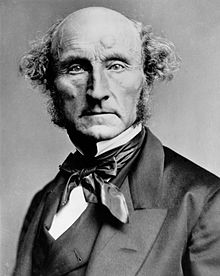
ON THE STUDY OF CLASSICS
From his Inaugural Address Delivered to the University of St. Andrews, 1867.
Even as mere languages, no modern European language is so valuable a discipline to the intellect as those of Greece and Rome, on account of their regular and complicated structure. Consider for a moment what grammar is. It is the most elementary part of logic. It is the beginning of the analysis of the thinking process. The principles and rules of grammar are the means by which the forms of language are made to correspond with the universal forms of thought. The distractions between the various parts of speech, between the cases of nouns, the moods and tenses of verbs, the functions of particles, are distinctions in thought, not merely in words. Single nouns and verbs express objects and events, many of which can be cognized by the senses: but the modes of putting nouns and verbs together, express the relations of objects and events, which can be cognized only by the intellect: and each different mode corresponds to a different relation. The structure of every sentence is a lesson in logic. The various rules of syntax oblige us to distinguish between the subject and predicate of a proposition, between the agent, the action, and the thing acted upon; to mark when an idea is intended to modify or qualify, or merely to unite with, some other idea; what assertions are categorical, what only conditional: whether the intention is to express similarity or contrast, to make a plurality of assertions conjunctively or disjunctively; what portions of a sentence, though grammatically complete within themselves, are mere members or subordinate parts of the assertion made by the entire sentence. Such things form the subject-matter of universal grammar: and the languages which teach it best are those which have the most definite rules, and which provide distinct forms for the greatest number of distinctions in thought, so that if we fall to attend precisely and accurately to any of these, we cannot avoid committing a solecism in language. In these qualities the classical languages have an incomparable superiority over every modern language, and over all languages, dead or living, which have a literature worth being generally studied.
But the superiority of the literature itself, for purposes of education, is still more marked and decisive. Even in the substantial value of the matter of which it is the vehicle, it is very far from having been superseded. The discoveries of the ancients in science have been greatly surpassed, and as much of them as is still valuable loses nothing by being incorporated in modern treatises: but what does not so well admit of being transferred bodily, and has been very imperfectly carried off even piecemeal, is the treasure which they accumulated of what may be called the wisdom of life: the rich store of experience of human nature and conduct, which the acute and observing minds of those ages, aided in their observations by the greater simplicity of manners and life, consigned to their writings, and most of which retains all its value The speeches in Thucydides: the Rhetoric, Ethics, and Politics of Aristotle, the Dialogues of Plato: the Orations of Demosthenes: the Satires, and especially the Epistles of Horace, all the writings of Tacitus: the great work of Quintilian, a repertory of the best thoughts of the ancient world on all subjects connected with education: and, in a less formal manner, all that is left to us of the ancient historians, orators, philosophers, and even dramatists, are replete with remarks and maxims of singular good sense and penetration, applicable both to political and to private life. and the actual truths we find in them are even surpassed in value by the encouragement and help they give us in the pursuit of truth. Human invention has never produced anything so valuable, in the way both of stimulation and of discipline to the inquiring intellect, as the dialectics of the ancients, of which many of the works of Aristotle illustrate the theory, and those of Plato exhibit the practice. No modern writings come near to these, in teaching, both by precept and example, the way to investigate truth, on those subjects, so vastly important to us, which remain matters of controversy, from the difficulty, or impossibility of bringing them to a directly experimental test. To question all things; never to turn away from any difficulty, to accept no doctrine either from ourselves or from other people without a rigid scrutiny by negative criticism, letting no fallacy, or incoherence, or confusion of thought, slip by unperceived: above all, to insist upon having the meaning of a word clearly understood before using it, and the meaning of a proposition before assenting to it; these are the lessons we learn from the ancient dialecticians. With all this vigorous management of the negative element, they inspire no scepticism about the reality of truth, or indifference to its pursuit. The noblest enthusiasm, both for the search after truth and for applying it to its highest uses, pervades these writers, Aristotle no less than Plato, though Plato has incomparably the greater power of imparting those feelings to others. In cultivating, therefore, the ancient languages as our best literary education, we are all the while laying an admirable foundation for ethical and philosophical culture. In purely litererary excellence–in perfection of form–the pre-eminence of the ancients is not disputed, In every department which they attempted, and they attempted almost all, their composition, like their sculpture, has been to the greatest modem artists an example, to be looked up to with hopeless admiration, but of inappreciable value as a light on high, guiding their own endeavours. In prose and in poetry, in epic, lyric, or dramatic, as in historical, philosophical, and oratorical art, the pinnacle on which they stand is equally eminent.
* * *
* * *
James Russell Lowell(1819-1891)
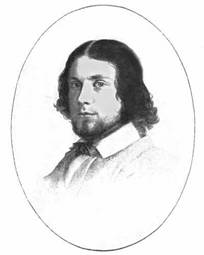
From In Defense of the Study of Greek.
Only those languages can properly be called dead in which nothing living has been written. If the classic languages are dead, they yet speak to us, and with a clearer voice than that of any living tongue. If their language is dead, yet the literature it enshrines is rammed with life as perhaps no other writing, except Shakespeare’s, ever was or will be. It is as contemporary with to-day as with the ears it first enraptured, for it appeals not to the man of then or now, but to the entire round of human nature itself. Men are ephemeral or evanescent, but whatever page the authentic soul of man has touched with her immortalizing finger, no matter how long ago, is still young and fair as it was to the world’s gray fathers. Oblivion looks in the face of the Grecian Muse only to forget her errand. Plato and Aristotle are not names but things. On a chart that should represent the firm earth and wavering oceans of the human mind, they would be marked as mountain-ranges, forever modifying the temperature, the currents, and the atmosphere of thought, astronomical stations whence the movements of the lamps of heaven might best be observed and predicted.
* * *
* * *
Friedrich Nietzsche(1844-1900)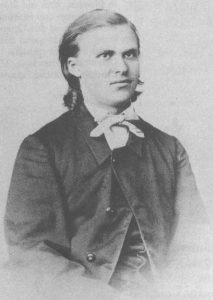
On Classical Philology
(from the end of the Preface to The Dawn or Daybreak)
Besides, we are friends of the lento, I and my book. I have not been a philologist in vain — perhaps I am one yet: a teacher of slow reading. I even come to write slowly. At present it is not only my habit, but even my taste — a perverted taste, maybe — to write nothing but what will drive to despair every one who is “in a hurry.” For philology is that venerable art which exacts from its followers one thing above all — to step to one side, to leave themselves spare moments, to grow silent, to become slow — the leisurely art of the goldsmith applied to language: an art which must carry out slow, fine work, and attains nothing if not lento. Thus philology is now more desirable than ever before; thus it is the highest attraction and incitement in an age of “work”: that is, of haste, of unseemly and immoderate hurry-skurry, which is so eager to “get things done” at once, even every book, whether old or new. Philology itself, perhaps, will not so hurriedly “get things done”. It teaches how to read well, that is, slowly, profoundly, attentively, prudently, with inner thoughts, with the mental doors ajar, with delicate fingers and eyes.* My patient friends, this book appeals only to perfect readers and philologists: learn to read me well!
Ruta, near Genoa, Autumn, 1886.
(Added to the 1881 Edition)
* Completely reverse this sentence, and you get exactly what to fight against: reading fast, shallowly, inattentively, imprudently, without inner thoughts, with the mental doors locked, not palpating with the fingers, and not visualizing! The whole passage could be the motto for any good Latin or Greek class.
On the Greeks
from The Birth of Tragedy, 1872, ch. XV (tr. Francis Golffing)
Practically every era of Western civilization has at one time or another tried to liberate itself from the Greeks, in deep dissatisfaction because whatever they themselves achieved, seemingly quite original and sincerely admired, lost color and life when held against the Greek model and shrank to a botched copy, a caricature. Time and again a hearty anger has been felt against that presumptuous little nation which had the nerve to brand, for all time, whatever was not created on its own soil as “barbaric.” Who are these people, whose historical splendor was ephemeral, their institutions ridiculously narrow, their mores dubious and sometimes objectionable, who yet pretend to the special place among the nations which genius claims among the crowd? None of the later detractors was fortunate enough to find the cup of hemlock with which such a being could be disposed of once and for all: all the poisons of envy, slander, and rage have proved insufficient to destroy that complacent magnificence.
* * *
* * *
John William Mackail(1859– 1945)
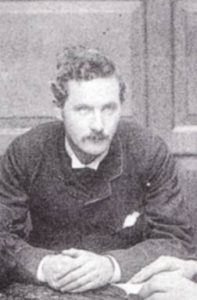
W. Mackail, Professor of Poetry at Oxford (1906-11), official at the Ministry of Education (1884-1919), President of the British Academy (1932-6), translator, author of many works on ancient literature, especially Vergil. I quote from the last page of his very beautiful little book called Latin Literature(London 1899):
Latin is now no longer a universal language; and the direct influence of ancient Rome, which once seemed like an immortal energy, is at last, like all energies, becoming slowly absorbed in its own results. Yet the Latin language is still the necessary foundation of one half of human knowledge, and the forms created by Roman genius underlie the whole of our civilisation. So long as mankind look before and after, the name of Rome will be the greatest of those upon which their backward gaze can be turned. In Greece men first learned to be human: under Rome mankind first learned to be civilised. Law, government, citizenship, are all the creations of the Latin race.
At a thousand points we still draw directly from the Roman sources. The codes of Latin jurists are the direct source of all systems of modern law. The civic organisation which it was the great work of the earlier Roman Empire to spread throughout the provinces is the basis of our municipal institutions and our corporate social life. The names of our months are those of the Latin year, and the modern calendar is, with one slight alteration, that established by Julius Caesar. The head of the Catholic Church is still called by the name of the president of a Republican college which goes back beyond the beginnings of ascertained Roman history [i.e. ‘Pontifex maximus’]. The architecture which we inherit from the Middle Ages, associated by an accident of history with the name of the Goths, had its origin under the Empire, and may be traced down to modern times, step by step, from the basilica of Trajan and the palace of Diocletian.
These are but a few instances of the inheritance we have received from Rome. But behind the ordered structure of her law and government, and the majestic fabric of her civilisation, lay a vital force of even deeper import; the strong grave Roman character, which has permanently heightened the ideal of human life. It is in their literature that the inner spirit of the Latin race found its most complete expression. In the stately structure of that imperial language they embodied those qualities which make the Roman name most abidingly great — honour, temperate wisdom, humanity, courtesy, magnanimity; and the civilised world still returns to that fountain-head, and finds a second mother-tongue in the speech of Cicero and Virgil.
* * *
* * *
A. N. Whitehead(1861-1947) 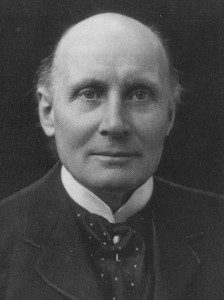
ON THE STUDY OF LATIN
Alfred North Whitehead was a great British mathematician and philosopher. This passage is from Ch. V. “The Place of Classics in Education”, in The Aims of Education and Other Essays. New York: The Free Press, 1929. I here quote only a little of it, but the entire chapter is richly worth reading.
The elements of Latin exhibit a peculiarly plain concrete case of language as a structure. Provided that your mind has grown to the level of that idea, the fact stares you in the face. You can miss it over English and French. Good English of a simple kind will go straight into slipshod French, and conversely good French will go into slipshod English. The difference between the slipshod French of the literal translation and the good French, which ought to have been written, is often rather subtle for that stage of mental growth, and is not always easy to explain. Both languages have the same common modernity of expression. But in the case of English and Latin the contrast of structure is obvious, and yet not so wide as to form an insuperable difficulty.
According to the testimony of schoolmasters, Latin is rather a popular subject; I know that as a schoolboy I enjoyed it myself. I believe that this popularity is due to the sense of enlightenment that accompanies its study. You know that you are finding out something. The words somehow stick in the sentences in a different way to what they do either in English or French, with odd queer differences of connotation. Of course in a way Latin is a more barbaric language than English. It is one step nearer to the sentence as the unanalysed unit.
This brings me to my next point. In my catalogue of the gifts of Latin I placed philosophy between logic and history. In this connection, that is its true place. The philosophic instinct which Latin evokes, hovers between the two and enriches both. The analysis of thought involved in translation, English to Latin or Latin to English, imposes that type of experience which is the necessary introduction to philosophic logic. If in after life your job is to think, render thanks to Providence which ordained that, for five years of your youth, you did a Latin prose once a week and daily construed some Latin author. The introduction to any subject is the process of learning by contact. To that majority of people for whom language is the readiest stimulus to thought-activity, the road towards enlightenment of understanding runs from simple English grammar to French, from French to Latin, and also traverses the elements of Geometry and of Algebra. I need not remind my readers that I can claim Plato’s authority for the general principle which I am upholding.
* * *
* * *
Pope John XXIII(1881-1963)
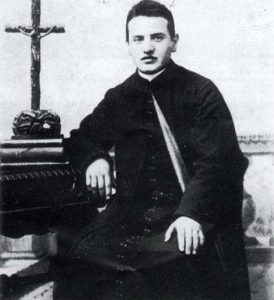
APOSTOLIC CONSTITUTION
ON PROMOTING THE STUDY OF LATIN
Part I: THE VALUE AND IMPORTANCE OF LATIN
- The Church’s Heritage
[1] THE WISDOM OF THE ANCIENT WORLD, enshrined in Greek and Roman literature, and the truly memorable teaching of ancient peoples, served, surely, to herald the dawn of that gospel which God’s Son, ‘the judge and teacher of grace and truth, the light and guide of the human race’, 1 proclaimed on earth. Such, at any rate, was the view of the Church’s Fathers and Doctors. In these outstanding literary monuments of antiquity they recognized man’s spiritual preparation for the supernatural riches which Jesus Christ communicated to mankind ‘to give history its fulfilment’. 2Thus the inauguration of Christianity did not mean the obliteration of man’s past achievements. Nothing was lost that was in any way true, right, noble, and beautiful.
[2] The Church has ever held the literary evidences of this wisdom in the highest esteem. She values especially the Greek and Latin languages, in which wisdom itself is cloaked, as it were, in a vesture of gold. She has likewise welcomed the use of other venerable languages, which flourished in the East, for these too have had no little influence on the progress of humanity and civilization. By their use in sacred liturgies and versions of Holy Scripture they have remained in force in certain regions even to the present day, bearing constant witness to the living voice of antiquity.
[3] But amid this variety of languages a primary place must surely be given to that language which had its origins in Latium and later proved so admirable a means for the spreading of Christianity throughout the West. And since in God’s special providence this language united so many nations together under the authority of the Roman Empire – and that for so many centuries – it also became the rightful language of the Apostolic See. 3 It was thus preserved for posterity and was instrumental in joining the Christian peoples of Europe together in the close bonds of unity.
- The cultural value of Latin
[4]. Of its very nature Latin is most suitable for promoting every form of culture among peoples. It gives rise to no jealousies. It does not favour any one nation, but presents itself with equal impartiality to all, and is equally acceptable to all. Nor must we overlook the characteristic nobility of Latin’s formal structure. Its ‘concise, varied, and harmonious style, full of majesty and dignity’, 4 makes for singular clarity and impressiveness of expression.
- Its religious value
[5] For these reasons the Apostolic See has always been at pains to preserve Latin, deeming it worthy of being used in the exercise of her teaching authority ‘as the splendid vesture of her heavenly doctrine and sacred laws’. 5 She further requires her sacred ministers to use it, for by so doing they are the better able, wherever they may be, to acquaint themselves with the mind of the Holy See on any matter, and communicate the more easily with Rome and with one another.
[6] Thus the ‘knowledge and use of this language’, so intimately bound up with the Church’s life, ‘is important not so much on cultural or literary grounds as for religious reasons’. 6 These are the words of Our Predecessor, Pius XI, who conducted a scientific enquiry into this whole subject and indicated three qualities of the Latin language which harmonize to a remarkable degree with the Church’s nature. ‘For the Church, precisely because it embraces all nations and is destined to endure until the end of time … of its very nature requires a language which is universal, immutable, and non-vernacular.’ 7
- The Church’s living language
(a) Universal
[7] Since ‘every Church must assemble round the Roman Church’. 8 and since the Supreme Pontiffs have ‘true episcopal power, ordinary and immediate, over each and every Church and over each and every Pastor, as well as over the faithful’ 9 of every rite and every language, it seems particularly desirable that the instrument of mutual communication be uniform and universal, especially between the Apostolic See and the Churches which use the same Latin rite. When, therefore, the Roman Pontiffs wish to instruct the Catholic world, or the Congregations of the Roman Curia handle affairs or draw up decrees which concern the whole body of the faithful, they invariably make use of Latin, for this is the ‘mother tongue’ acceptable to countless nations.
(b) Immutable
[8] Furthermore, the Church’s language must be not only universal but also immutable. Modern languages are liable to change, and no single one of them is superior to the others in authority. Thus if the truths of the Catholic Church were entrusted to an unspecified number of them, the meaning of these truths, varied as they are, would not be manifested to everyone with sufficient clarity and precision. There would, moreover, be no language that could serve as a common and constant norm by which to gauge the exact meaning of other renderings. But Latin is indeed such a language. It is set and unchanging. It has long since ceased to be affected by those alterations in the meaning of words which are the normal result of daily, popular use. Certain Latin words, it is true, acquired new meanings as Christian teaching developed and needed to be explained and defended, but these new meanings have long since become accepted and firmly established.
(c) Non-vernacular
[9] Finally, the Catholic Church has a dignity far surpassing that of every merely human society, for it was founded by Christ the Lord. It is altogether fitting, therefore, that the language it uses should be noble and majestic, and non-vernacular.
- Other advantages of Latin: its educational value
[10] In addition, the Latin language ‘can be called truly Catholic’. 10 It has been consecrated through constant use by the Apostolic See, the mother and teacher of all Churches, and must be esteemed ‘e treasure . . . of incomparable worth’. 11 It is a general passport to the proper understanding of the Christian writers of antiquity and the documents of the Church’s teaching. 12 It is also a most effective bond, binding the Church of today with that of the past and of the future in wonderful continuity.
[11] There can be no doubt as to the formative and educational value of the language of the Romans and of great literature generally. It is a most effective training for the pliant minds of youth. It exercises, matures and perfects the principal faculties of mind and spirit. It sharpens the wits and gives keenness of judgment. It helps the young mind to grasp things accurately, and develop a true sense of values. It is also a means for teaching highly intelligent thought and speech.
- The Church’s policy with regard to Latin
[12] It will be quite clear from these considerations why the Roman Pontiffs have so often extolled the excellence and importance of Latin, and why they have prescribed its study and use by the secular and regular clergy, forecasting the dangers that would result from its neglect.
[13] And We also, impelled by the weightiest of reasons – the same as those which prompted Our Predecessors and provincial synods 13 – are fully determined to restore this language to its position of honour and to do all We can to promote its study and use. The employment of Latin has recently been contested in some quarters, and many are asking what the mind of the Apostolic See is in this matter. We have therefore decided to issue the timely directives contained in this document, so as to ensure that the ancient and uninterrupted use of Latin be maintained and, where necessary, restored.
[14] It seems to Us We made Our own views on this subject sufficiently plain in Our address to some eminent Latin scholars. ‘It is a matter of regret’, We said, ‘that so many people, unaccountably dazzled by the marvellous progress of science, are taking it upon themselves to oust or restrict the study of Latin and other kindred subjects … Yet in spite of the urgent need for science, Our own view is that the very contrary policy should be followed. The greatest impression is made on the mind by those things which correspond more closely to man’s nature and dignity, and therefore the greater zeal should be shown in the acquisition of whatever educates and enobles the mind. Otherwise poor mortal creatures may well become like the machines they build – cold, hard, and devoid of love’. 14
PART II: PROVISIONS FOR THE PROMOTION OF THE STUDY OF LATIN
[15] With the foregoing considerations in mind, to which We have given careful thought, We now, in the full consciousness of Our office and in virtue of Our authority, decree and command the following:
- Bishops and superiors-general of religious orders shall be at pains to ensure that in their seminaries, and in their schools where adolescents are trained for the priesthood, all shall studiously observe the Apostolic See’s decision in this matter and obey these Our prescriptions most carefully.
- In the exercise of their paternal care they shall be on their guard lest anyone under their jurisdiction, being eager for innovation (novarum rerum studios), writes against the use of Latin in the teaching of the higher sacred studies or in the liturgy, or through prejudice makes light of the Holy See’s will in this regard or interprets it fa1sely.
- As is laid down in Canon Law (can. 1364) or commanded by Our Predecessors, before Church students begin their ecclesiastica1 studies proper they shall be given a sufficiently lengthy course of instruction in Latin by highly competent masters following a method designed to teach them the language with the utmost accuracy. ‘And that too for this reason: lest later on, when they begin their major studies … they are unable by reason of their ignorance of the language to gain a full understanding of the doctrines or take part in those scholastic disputations which constitute so excellent an intellectual training for young men in the defence of the faith.’15We wish the same rule to apply to those whom God calls to the priesthood later on in life and whose classical studies have either been neglected or conducted too superficially. No one is to be admitted to the study of philosophy or theology except he be thoroughly and perfectly grounded in this language and capable of using it.
- Wherever the study of Latin has suffered partial eclipse through the assimilation of the academic programme to that which obtains in State schools, with the result that the instruction given is no longer so thorough and well grounded as formerly, there the traditional method of teaching this language shall be completely restored. Such is Our will, for there should be no doubt in anyone’s mind about the necessity of keeping a strict watch over the course of studies followed by Church students; and that not only as regards the number and kind of subjects they study, but also as regards the length of time devoted to the teaching of these subjects. Should circumstances of time and place demand the addition of other subjects to the curriculum besides the usual ones, then either the course of studies must be lengthened, or these additional subjects must be condensed or their study relegated to another time.
- In accordance with numerous previous instructions, the major sacred sciences shall be taught in Latin, which, as we know from many centuries of use, ‘must be considered most suitable for explaining with the utmost facility and clarity the most difficult and profound ideas and concepts’.16For apart from the fact that it has long since been enriched with a vocabulary of appropriate and unequivocal terms best calculated to safeguard the integrity of the Catholic faith, it also serves in no slight measure to prune away useless verbiage. Hence the professors of these sciences in universities or seminaries are required to speak Latin and to make use of textbooks written in Latin. Those whose ignorance of Latin makes it difficult for them to obey these instructions shall gradually be replaced by professors who are suited to this task. Any difficulties that may be advanced by students or professors must be overcome either by the patient insistence of the bishops or religious superiors, or by the good will of the professors.
- Since Latin is the Church’s living language, it must be adequate to daily increasing linguistic requirements. It must be furnished with new words that are apt and suitable for expressing modern things, words that will be uniform and universal in their application and constructed in conformity with the genius of the ancient Latin tongue. Such was the method followed by the sacred Fathers and the best scholastic writers. To this end, therefore, We commission the Sacred Congregation of Seminaries and Universities to set up a Latin Academy staffed by an international body of competent Latin and Greek professors. The principal aim of this Academy – like the national academies founded to promote their respective languages – will be to superintend the proper development of Latin, augmenting the Latin lexicon where necessary with words which conform to the particular character and colour of the language. It will also conduct schools for the study of Latin of every era, particularly the Christian one. The aim of these schools will be to impart a fuller understanding of Latin and the ability to use it and to write it with proper elegance. They will exist for those who are destined to teach Latin in seminaries and ecclesiastical colleges, or to write decrees and judgments or conduct correspondence in the ministries of the Holy See, diocesan curias, and the offices of religious orders.
- Latin is closely allied to Greek both in formal structure and the importance of its extant writings. Hence – as Our Predecessors have frequently ordained – future ministers of the altar must be instructed in Greek in the lower and middle schools. Thus, when they come to study the higher sciences – and especially if they are aiming for a degree in Sacred Scripture or.theology – they will be enabled to follow the Greek sources of scholastic philosophy and understand them correctly; and not only these, but also the original texts of Sacred Scripture, the liturgy, and the sacred Greek Fathers. 17
- We further commission the Sacred Congregation of Seminaries and Universities to prepare a syllabus for the teaching of Latin which all shall faithfully observe. The syllabus will be designed to give those who follow it an adequate understanding of the language and its use. Bishops in conference may indeed rearrange this syllabus if circumstances warrant, but they must never curtail it or alter its nature. Ordinaries may not take it upon themselves to put their own proposals into effect until these have been examined and approved by the Sacred Congregation. [16] Finally, in virtue of Our Apostolic Authority, We will and command that all the decisions, decrees, proclamations and recommendations of this Our Constitution remain firmly established and ratified, notwithstanding anything to the contrary however worthy of special note.
Given at Rome, at St Peter’s, on the feast of St.Peter’s Throne, on the 22nd day of February, in the year 1962, the fourth of Our Pontificate. JOHN PP. XXIII
N O T E S
- Tertullian, ApoL 21; MIgne, P.L. I, p.394.
- Eph. 1:10.
- Epist. S. Cong. Stud. Vehementer sane, ad Ep. universos, 1 July 1908; Ench. Cler., N. 820. Cf. also Epist. Ap. Pii XI, Unigenitus Dei Filius, 19 Mar. 1924; A.A.S. xvi (1924), p.l41.
- Pius XI, Epist. Ap. Officiorum omnium, 1 Aug. 1922; A.A.S. XIV (1922), pp. 452-453.
- Pius XI, Motu Proprio Litterarum latinarum 20 Oct. 1924; A.A.S. XVI (1924), p.417.
- Pius XI, Epist. Ap. Officiorum omnium, 1 Aug. 1922; A.A.S. XIV (1922), p.452.
- Ibid.
- St Iren., Adv. Haer. 3, 3, 2; Migne, P.G. VII, p.848.
- Cf. C.I.C., can. 218, sec. 2.
- Cf. Pius XI, Epist. Ap. Officiorum omnium, 1 Aug. 1922; A.A.S. XIV (1922), p. 453.
- Pius XII Alloc. Magis quam, 23 Nov. 1951, A.A.S. XLIII (1951), p. 737.
- Leo XIII, Epist. Encycl. Depuis le jour, 8 Sept. 1899, Acta Leonis XIII, XIX (1899) p. 166.
- Cf. Collectio Lacensis, especially: vol. III, p. 1018. (Conc. Prov. Westmonasteriense, a. 1859); vol. IV, p. 29 (Cone. Prov. Parisiense, a. 1849) vol. IV, pp. l49, 153 (Col. Prov. Rhemense, a. 1849); vol. IV, pp. 359, 36; (Cone. Prov. Avenionense, a. 1849); vol. IV, pp. 394, 396 (Cone. Prov. Burdigalense, a. 1850); vol. V, p.61 (Cone. Strigoniense, a. 1858); vol. V, p. 664 (Cone. Prov. Colocense, a. 1863); vol. VI, p.619 (Synod. Vicariatus Suchnensis, a. 1803).
- International Convention for the Promotion of Ciceronian Studies, 7 Sept. 1959, in Discorsi Messaggi Collogui of the Holy Father John XXIII, I, pp. 234; cf. also Address to Roman pilgrims of the Diocese of Piacenza, 15 April 1959: L’Osservatore Rom., 16 April 1959; Epist. Pater misericordiarum, 22 Aug. 1961, A.A.S. LIII (1961), p. 677; Address given on the occasion of the solemn inauguration of the College of the Philippine Islands at Rome, 7 Oct. 1961: L’Osservatore Rom. 9-10 Oct. 1961; Epist. Iucunda laudatio, 8 Dec. 1961: A.A.S. LIII (1961, p.812.
- Pius XI, Epist. Ap. Officiorum omnium, 1 Aug. 1922, A.A.S. XIV (1922), p. 453.
- Epist. S. C. Studiorum, Vehementer sane, 1 July 1908; Ench. Cler., n. 821.
- Leo XIII, Litt. Encycl. Providentissimus Deus, 18 Nov. 1893, Acta Leonis XIII, XIII (1893), p. 342, Epist. Plane quidem intelligis, 20 May 1885, Acta Leonis XIII, V, pp. 63-64, Pius XII, Alloc. Magis quam, 23 Sept. 1951, A.A.S. XLIII (1951), p. 737
* * *
* * *
Dorothy Sayers(1893-1957)
Latin grammar: the most practical subject
Dorothy Sayers was an English writer of detective novels and a superb translator of, and good commentator on, Dante.
Her father, who taught her Latin, was the dean of Christ’s Church, Oxford.
I call this a very lamentable history. Yet there are two things I feel bound to say with all the emphasis I can command. First: if you set aside classical specialists and the products of those public schools which still cling to the great tradition, I, mute and inglorious as I am, and having forgotten nearly all I ever learned, still know more Latin than most young people with whom I come in contact. Secondly: that if I were asked what, of all the things I was ever taught, has been of the greatest practical use to me, I should have to answer: the Latin Grammar.
An early grounding in the Latin Grammar has these advantages:
- It is the quickest and easiest way to gain mastery over one’s own language, because it supplies the structure upon which all language is built. I never had any formal instruction in English grammar, nor have I ever felt the need of it, though I find I write more grammatically than most of my juniors. It seems to me that the study of English grammar in isolation from the inflected origins of language must be quite bewildering. English is a highly sophisticated, highly analytical language, whose forms, syntax and construction can be grasped and handled correctly only by a good deal of hard reasoning, for the inflections are not there to enable one to distinguish automatically one case or one construction from another. To embark on any complex English construction without the Latin Grammar is like trying to find one’s way across country without map or signposts. That is why so few people nowadays can put together an English paragraph without being betrayed into a false concord, a hanging or wrongly attached participle, or a wrong consecution; and why many of them fall back upon writing in a series of short sentences, like a series of gasps, punctuated only by full stops.
- Latin is the key to fifty per cent. of our vocabulary—either directly, or through French and other Romance languages. Without some acquaintance with the Latin roots, the meaning of each word has to be learnt and memorised separately – including, of course, that of the new formations with which the sciences are continually presenting us. Incidentally, the vocabulary of the common man is becoming more and more restricted, and this is not surprising.
- Latin is the key to all the Romance languages directly, and indirectly to all inflected languages. The sort of argument which continually crops up in correspondence upon the teaching of Latin is: “Why should children waste time learning a dead language when Spanish or what-have-you would be much more useful to him in business?” The proper answer, which is practically never given, is the counter-question: “Why should a child waste time learning half a dozen languages from scratch, when Latin would enable him to learn them all in a fraction of the time?” When I wanted to work on Dante, I taught myself to read the mediaeval Italian in a very few weeks’ time, with the aid of Latin, an Italian Grammar, and the initial assistance of a crib. To learn to speak and write the modern tongue correctly would demand tuition and more time—but not much and not long. Old as I am, I would back myself to learn Spanish, Portuguese or Provencal with equal ease. But knowing French would not have helped me very much to read Italian, and I doubt whether, without the Latin substructure, Italian would help me very far with Portuguese; although, of course, the more languages one knows, the easier it is to learn more. It is difficult to be sure, because it is impossible for me to empty my mind of the Latin, even in imagination. But I know how very different a task it would be to start upon a language like Czech or Chinese, which would not open to the Latin key.
And I remember, too, in my own school-teaching days, being confronted by a class of girls of fifteen or sixteen, who had to have some German pumped into them for an exam. They had done French in the ordinary way, but now had to offer a second language. I remember saying—stupidly and without thinking, for I was still young—”No, you can’t say, ‘Ich bin gegeben ein Buch’, ‘I have been given’ isn’t a true Passive”. I remember their bewildered faces. And I remember realizing that we had come to the Wood where Things have no Names, and that everything would have to be laboriously thought out and explained from the very beginning. And that they hadn’t got much time.
- The literature of our own country and of Europe is so studded and punctuated with Latin phrases and classical allusions that without some knowledge of Latin it must be very difficult to make anything of it. Here we are getting away from the uses of grammar to the benefits of background and culture. I will therefore not say very much about it at this point, except to point out that the student of English history or English literature or English law is always encountering the odd tag, the Latin title, the isolated phrase, and that it must be quite maddening to have to stop and look them up every time in a reference book.
- There is also the matter of derivation, as distinct from vocabulary. I cannot help feeling that it is wholesome, for example, to know that “civility” has some connection with the civitas; that “justice” is more closely akin to righteousness than to equality; and that there was once some dim and forgotten connection between reality and thought.
* * *
* * *
Robert Graves (1895-1985) & Alan Hodge
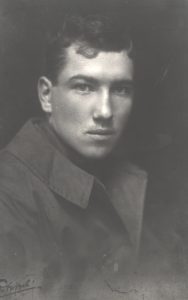
Robert Graves was a famous English poet of the 20th century, and the author of well over a hundred books, including (to name the most famous) his autobiographies Goodbye to All That and But It Still Goes On,The Greek Myths, The White Goddess, and I, Claudius. Here with his friend Alan Hodge he criticizes the prose of Sir Arthur Quiller Couch (Professor of English Lit. at Cambridge University and editor of the old Oxford Book of English Verse). Robert Graves and Alan Hodge, The Reader Over Your Shoulder, MacMillan 1943; repr. N.Y. 1961, p. 121-123:
ON AN UNLUCKY SENTENCE BY SIR ARTHUR QUILLER COUCH
‘Literature must needs take account of all manner of writers, audiences, moods, occasions; I hold it a sin against the light to put up a warning against any word that comes to us in the fair way of use and wont’ . . . and that, generally, it is better to err on the side of liberty than on the side of the censor: since by the manumitting of new words we infuse new blood into a tongue of which (or we have learnt nothing from Shakespeare) our first pride should be that it is flexible, alive, capable of responding to new demands of man’s untiring quest after knowledge and experience’ (Sir Arthur Quiller Couch, On the Art of Writing, 1916)
“Even in late victorian times, no person of Sir A. Quiller Couch’s eminence would have dared to publish a sentence so plainly grotesque as ‘By the manumitting of new words we infuse new blood into a tongue which is flexible, alive, capable of responding to new demands of man’s untiring quest after knowledge and experience.’ When the test of translation into Latin is applied, it fails at every point. No Latin orator would have figured new words as slaves to bemanumitted: he would have seen them as barbarians applying for citizenship. Nor would he have figured the act of manumission as infusing new blood into anything: he would have put in the step here left out, namely, that after manumission the former slaves would be permitted to marry into their masters’ families. Nor would he have mixed metaphor and realism in the phrase ‘infuse new blood into a tongue‘: for blood is usually infused into the veins of the arm or leg and never into a tongue. Nor would he have written of a tongue as ‘flexible and alive‘: he would have known that any human tongue unless its owner happens to be paralyzed, poisoned or frozen stiff, is flexible and alive. He would therefore have avoided the word lingua (which means ‘tongue’ in the senses both of speech and of the organ of speech) and used instead ‘modus loquendi‘, a ‘manner of speaking.’ Nor would he have admitted that a tongue into which new blood has been infused could ‘respond to man’s demands‘ as if it were a separate person or animal. Nor would he have mixed his vocabularies–Ennius with Petronius–as is done here: the Elizabethan phrase ‘I hold it a sin against the light to put up a warning against any word that comes to us in the fair way of use and wont‘ mixed with the late-Victorian devotional-scientific phrase ‘capable of responding to new demands of man’s untiring quest.'”
This criticism may seem pedantic! — but its basic point is right that in every word there sleeps a concrete image and that, if awakened, these images either work at cross-purposes and confuse the ideas, or work together to enhance them. Beyond that, some words have no sense except their “concrete” one. For example “the manumitting of new words” does simply mean that new words are slaves. It is as if he had said “the freeing of new words.” That idea perhaps is very interesting; but it is strange and needs explanation. But since it is at once forgotten–since the next image “infusing new blood” has no apparent relation to it–we have the terrible suspicion that Quiller Couch hardly knew what he meant.
The reference to Roman oratory is fair because this “poetic” passage does try for maximum resonance. Generally we use words with drab abstractness, without trying to waken the images that sleep inside them. On this page, when I write “image” I do not try to evoke a waxen death-mask in a torchlit Roman funeral procession; if I say “abstraction” I do not mean one thing being pulled out of another; if I say “concrete” I do not imagine ice, or curds, or concrete–etc. Graves and Hodge would not attack me for this. But Quiller Couch writing more “poetically” is trying (or half trying) to summon up these ghosts, and when you do that you become responsible for the consequences.
When you try to write “eloquently” Latin helps, for two reasons: (a) because the root-images of most English words are in Latin; (b) because the best Roman authors, though poorer than we in many respects, do show how “eloquence” is managed, i.e. how to use words with the abnormal force that is given by etymological exactness combined with clear grammar. (K.M.)
* * *
* * *
Leo Strauss(1899-1974)
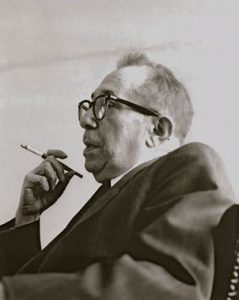
On Classical Political Philosophy
Leo Strauss was a great political philosopher. This is from his article “What is Political Philosophy?”
in The Journal of Politics, Vol. 19, No. 3, Aug., 1957, pp. 343-368.
Classical political philosophy is nontraditional, because it belongs to the fertile moment when all political traditions were shaken, and there was not yet in existence a tradition of political philosophy. In all later epochs, the philosophers’ study of political things was mediated by a tradition of political philosophy which acted like a screen between the philosopher and political things, regardless of whether the individual philosopher cherished or rejected that tradition. From this it follows that the classical philosophers saw the political things with a freshness and directness which has never been equalled. They look at political things in the perspective of the enlightened citizen or statesman. They see things clearly which the enlightened citizens or statesmen do not see clearly, or do not see at all. There is no other reason for this than the fact that they look further afield in the same direction as the enlightened citizens or statesmen. They do not look at political things from the outside, as spectators of political life. They speak the language of the citizens or statesmen; they hardly use a single term which is not familiar to the market place. Hence their political philosophy is comprehensive; it is both political theory and political skill; it is as receptive to the legal and institutional aspects of political life, as it is to that which transcends the legal and institutional; it is equally free from the narrowness of the lawyer, the brutality of the technician, the vagaries of the visionary, and the baseness of the opportunist. It reproduces, and raises to its perfection, the magnanimous flexibility of the true statesman, who crushes the insolent and spares the vanquished. It is free from all fanaticism because it knows that evil cannot be eradicated and therefore that one’s expectations from politics must be moderate. The spirit which animates it may be described as serenity or sublime sobriety.
Compared with classical political philosophy, all later political thought, whatever else its merits may be, and in particular modern political thought, has a derivative character. This means that in later times there has occurred an estrangement from the simple and primary issues. This has given to political philosophy the character of “abstractness,” and has therefore engendered the view that the philosophic movement must be a movement, not from opinion to knowledge, not from the here and now to what is always and eternal, but from the abstract toward the concrete. It was thought that by virtue of this movement toward the concrete, recent philosophy had overcome the limitations not only of modern political philosophy, but of classical political philosophy as well. It was overlooked, however, that this change of orientation perpetuated the original defect of modern philosophy because it accepted abstractions as its starting point, and that the concrete at which one eventually arrived was not at all the truly concrete, but still an abstraction.
* * *
* * *
Eric Voegelin (1901-1985)
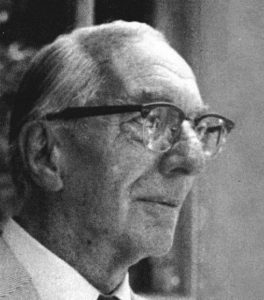
On the Classics
ON THE NEED TO READ A WRITER IN HIS OWN LANGUAGE. The acquisition of Greek was of course fundamental for my later work, not only so far as my knowledge of Greek philosophy was concerned, but: for understanding fundamentally that one cannot deal with materials unless one can read them.
That sounds trivial, but as I later found out, it is a truth not only neglected but hotly contested by a good number of persons who are employed by our colleges and who, with the greatest of ease, talk about Plato and Aristotle, or Thomas and Augustine, or Dante and Cervantes, or Rabelais or Goethe, without being able to read a line of the authors on whom they pontificate. (From Collected Works, vol. 34 p. 39)
ON ‘LANGUAGE SYMBOLS’. Symbols don’t just develop. Every word that we use in our language, that is now part of our language, was not lying around somewhere but was created by somebody—even terms like “quantity” and “quality.” We ask: who invented quantity and quality? Cicero. There wasn’t any quantity or quality before him.* Every such instrument of thought—even such elementary things—has been created, as far as the intellectual and spiritual origin is concerned, by certain people on certain occasions of experiences; and we usually are in possession of the early document.
As I said, the term “theology” begins in the Republic of Plato [379a]–that is an early example. The term “metaphysics” was introduced by Thomas for the first time in his proœmium to the Metaphysics of Aristotle. You can trace it back: “metaphysics” is an Arabic deformation of the Greek letters τὰ μετὰ τὰ φυσικά (which mean nothing of that sort)** and was taken over as a convenient term. In the seventeenth century “metaphysics” was replaced by the term “ontology” and that has become fashionable to a certain extent…. For every term you can say who, how, when and why that piece of language was produced. One has always to go back to that. So symbols don’t just happen. (fromConversations with Eric Voegelin, ed. R. E. O’Connor, Montreal, 1980, IV, 144-145.)
*Quantitas (‘how-muchness’) from quantus -a -um (‘how much’) imitates Greek ποσότης(Aristotle Met. 1028a19) from πόσος -η -ον. The word does not occur in the extant works of Cicero; but that he invented it seems likely. We know he coinedqualitas from qualis (‘of what sort’) imitating ποιότηςwhich Plato (Tht. 182a) had coined from ποῖος -α -ον (pronoun like qualis = ‘what sort of?’).
Of course Voegelin, here recorded in conversation, exaggerates with “There wan’t any quantity or quality before him”, and later with “For every term” etc. For in a sense the Greeks had ‘quantity’ and ‘quality’; also, there is a risky “argument from silence”, since we happen to have many of Cicero’s works preserved, but not those of his contemporaries. And many words are immemorial, not “coined” by anyone, but only discovered to have strange depths.
But of course he is right that very often you can discern exactly when, and why, a new term was coined, or when “new meanings” were discovered in an old one; and that if you ignore these concrete circumstances in which it emerged, you have not a chance of penetrating to its real meaning (for an example, see the next note).
**τὰ μετὰ τὰ φυσκικά means “the (works) after the Physics”; originally it was an ancient reference to the 13 treatises that, in editions of Aristotle, traditionally came after those on physics and natural sciences. The Arabs (and Westerners after them) mistook this purely descriptive phrase for a title and a concept. Acquinas may not have been the first to do this. Voegelin’s point is that Aristotle never wrote a “Metaphysics”, that the very concept is foreign to him, and that for people ignorant of its origin (that is, most people), this term tends to be fatally misleading.
* * *
* * *
Lewis Thomas(1913-1993)
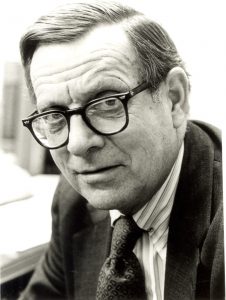
How to Fix the Premedical Curriculum
(with classical Greek)
FromThe Medusa and the Snail,1979, p. 137-141 (on Thomas see note below)
The influence of the modern medical school on liberal-arts education in this country over the last decade has been baleful and malign, nothing less. The admission policies of the medical schools are at the root of the trouble. If something is not done quickly to change these, all the joy of going to college will have been destroyed, not just for that growing majority of undergraduate students who draw breath only to become doctors, but for everyone else, all the students, and all the faculty as well.
The medical schools used to say that they wanted applicants as broadly educated as possible, and they used to mean it. The first two years of medical school were given over almost entirely to the basic biomedical sciences, and almost all entering students got their first close glimpse of science in those years. Three chemistry courses, physics, and some sort of biology were all that were required from the colleges. Students were encouraged by the rhetoric of medical-school catalogues to major in such nonscience disciplines as history, English, philosophy. Not many did so; almost all premedical students in recent generations have had their majors in chemistry or biology. But anyway, they were authorized to spread around in other fields if they wished.
There is still some talk in medical deans’ offices about the need for general culture, but nobody really means it, and certainly the premedical students don’t believe it. They concentrate on science.
They concentrate on science with a fury, and they live for grades. If there are courses in the humanities that can be taken without risk to class standing they will line up for these, but they will not get into anything tough except science. The so-called social sciences have become extremely popular as stand-ins for traditional learning.
The atmosphere of the liberal-arts college is being poisoned by premedical students. It is not the fault of the students, who do not start out as a necessarily bad lot. They behave as they do in the firm belief that if they behave any otherwise they won’t get into medical school.
I have a suggestion, requiring for its implementation the following announcement from the deans of all the medical schools: henceforth, any applicant who is self-labeled as a “premed,” distinguishible by his course selection from his classmates, will have his dossier placed in a third stack of three. Membership in a “premedical society” will, by itself, be grounds for rejection. Any college possessing something called a “premedical curriculum,” or maintaining offices for people called “premedical advisors,” will be excluded from recognition by the medical schools.
Now as to grades and class standing. There is obviously no way of ignoring these as criteria for acceptance, but it is the grades in general that should be weighed. And, since so much of the medical-school curriculum is, or ought to be, narrowly concerned with biomedical science, more attention should be paid to the success of students in other, nonscience disciplines before they are admitted, in order to assure the scope of intellect needed for a physician’s work.
Hence, if there are to be MCAT tests, the science part ought to be made the briefest, and weigh the least. A knowledge of literature and languages ought to be the major test, and the scariest. History should be tested, with rigor.
The best thing would be to get rid of the MCATs, once and for all, and rely instead, wholly, on the judgment of the college faculties.
You could do this if there were some central, core discipline, universal within the curricula of all the colleges, which could be used for evaluating the free range of a student’s mind, his tenacity and resolve, his innate capacity for the understanding of human beings, and his affection for the human condition. For this purpose, I propose that classical Greek be restored as the centerpiece of undergraduate education. The loss of Homeric and Attic Greek from American college life was one of this century’s disasters. Putting it back where it once was would quickly make up for the dispiriting impact which generations of spotty Greek in translation have inflicted on modern thought. The capacity to read Homer’s language closely enough to sense the terrifying poetry in some of the lines could serve as a shrewd test for the qualities of mind and character needed in a physician.
If everyone had to master Greek, the college students aspiring to medical school would be placed on the same footing as everyone else, and their identifiability as a separate group would be blurred, to everyone’s advantage. Moreover, the currently depressing drift on some campuses toward special courses for prelaw students, and even prebusiness students, might be inhibited before more damage is done.
Latin should be put back as well, but not if it is handled, as it ought to be, by the secondary schools. If Horace has been absorbed prior to college, so much for Latin. But Greek is a proper discipline for the college mind.
English, history, the literature of at least two foreign languages, and philosophy should come near the top of the list, just below classics, as basic requirements, and applicants for medical school should be told that their grades in these courses will count more than anything else.
Students should know that if they take summer work as volunteers in the local community hospital, as ward aides or laboratory assistants, this will not necessarily be held against them, but neither will it help.
Finally, the colleges should have much more of a say about who goes on to medical school. If they know, as they should, the students who are generally bright and also respected, their judgment should carry the heaviest weight for admission. If they elect to use criteria other than numerical class standing for recommending applicants, this evaluation should hold.
The first and most obvious beneficiaries of this new policy would be the college students themselves. There would no longer be, anywhere where they could be recognized as a coherent grup, the “premeds,” that most detestable of all cliques eating away at the heart of college. Next to benefit would be the college faculties, once again in possession of the destiny of their own curriculum, for better or worse. And next in line, but perhaps benefitting the most of all, are the basic-science faculties of the medical schools, who would once again have classrooms full of students who are ready to be startled and excited by a totally new and unfamiliar body of knowledge, eager to learn, unpreoccupied by notions of relevance that are paralyzing the minds of today’s first-year medical students already so surfeited by science that they want to start practicing psychiatry in the first trimester of the first year.
Society would be the ultimate beneficiary. We could look forward to a generation of doctors who have learned as much as anyone can learn, in our colleges and universities, about how human beings have always lived out their lives. Over the bedrock of knowledge about our civilization, the medical schools could then construct as solid a structure of medical science as can be built, but the bedrock would always be there, holding everything else upright.
===
Lewis Thomas (1913-1993) was a physician, poet, etymologist, essayist, administrator, educator, policy advisor, and researcher. He was born in Flushing, New York and attended Princeton University and Harvard Medical School. He became Dean of Yale Medical School and New York University School of Medicine, and President of Memorial Sloan-Kettering Institute. He was invited to write regular essays in the New England Journal of Medicine, and won a National Book Award for the 1974 collection of those essays, The Lives of a Cell. He also won a Christopher Award for this book. Two other collections of essays (from NEJM and other sources) are The Medusa and the Snail and Late Night Thoughts on Listening to Mahler’s Ninth Symphony. His autobiography, The Youngest Science: Notes of a Medicine Watcher is a record of a century of medicine and the changes which occurred in it. He also published a book on etymology entitled Et Cetera, Et Cetera, poems, and numerous scientific papers. ( . . . ) Thomas is noted for his eclectic interests and superlative prose style and is often quoted. The Lewis Thomas Prize is awarded annually by The Rockefeller University to a scientist for artistic achievement.
* * *
* * *
Jasper Griffin(1937 – )
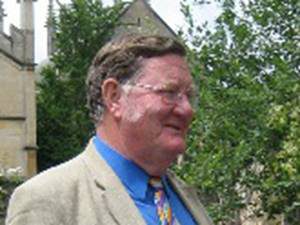
On English Poets and the Classics
and On A Classical Education
Jasper Griffin is an Oxford classicist, educated at Christ’s Hospital and Balliol College, Oxford and the author of (among other things) a splendid book called Homer on Life and Death. What follows are excerpts from a book by his friend Ved Mehta, Up at Oxford (NY 1992), in which chapter IX (pp. 277-333) are a memoir of his friendship with Griffin. The whole chapter is well worth reading, especially its pages describing Griffin’s classical schooling at Christ’s Hospital; I here quote just a little:
ON ENGLISH POETS & THE CLASSICS (p. 278-279). I often wished that, like Jasper, I had had a classical education; so much of the English literature I read seemed to be influenced by the classics. I had a conversation with him on the subject not long ago.
“Until the twentieth century, anyone in England who had any kind of education at all had an education in the classics,” he said. “Until the university reforms of the eighteen-seventies, all education at Oxford and Cambridge was in that tradition. And, yes, it is true that a lot of English literature is influenced by the classics. Dr. Johnson wrote poems in Latin. Marlowe translated big chunks of the Aeneid, and his ‘Dido, Queen of Carthage’ contains bits out of its fourth book. Milton wrote a lot of poems in Latin, and the whole style of ‘Paradise Lost’ is really unintelligible unless one knows Latin and is familiar with Latin epics. Dryden and Pope were the greatest of translators from the Latin and Greek. Pope made his name and fortune translating Homer, and his best poems are explicit imitations of classical poets. He wrote these marvellous poems called ‘Imitations of Horace.’ People like Wordsworth, Coleridge, and Shelley were all very keen on Greek. Keats was perhaps an exception. He wasn’t a gent—he was mostly self-educated—but he picked up as much Greek as he could. In fact, it may have meant more to him because he learned it himself. Tennyson was tremendously keen on Virgil and wrote a very fine poem on him. Arthur Hugh Clough wrote English poems in hexameters. Matthew Arnold was a considerable scholar of the classics, and Gerard Manley Hopkins wrote poems in Latin, which you have no doubt seen in the back of the collected poems. Eliot knew the classics pretty well, too. He was very much interested in Heraclitus and Virgil. There’s not much Greek and Latin in his poems, though—there’s more French. Louis MacNeice read Greats at Merton. The truth is that if you want to study English literature at all, even that of the twentieth century, you have to know some of the classics. It is really extraordinary how there is a sort of symbiosis between English literature and the classics. In fact, people who don’t know the classics are sometimes quite baffled by things English poets say.
ON GRIFFIN’S CLASSICAL EDUCATION (p. 329-331). “How would you go about defending such an extravagant and harsh system of education?” I asked.
“I think that when one is young it’s important to be made to do things with intensity. Not absolutely everything, and not all the time—or you would crack up—but something. Children may from moment to moment say that they would rather take this easy and the next thing easy and the next thing easy, but actually, when it comes down to it, they don’t want to. Though there’s an increasing tendency to make education intellectually very easy, I firmly believe that if you don’t acquire the ability to do some thing difficult when you are young you will never have it. Doing things like memorizing poetry and learning skills for maths can be done with great ease when one is a child. Then the mind is like a blob of sealing wax. If you hit it while it’s still hot and soft, you can make a sharp, clear, lasting impression. If you wait too long, it’s cold and hard. To put it another way, a good classical education will produce a mind that is capable of stretching itself. A less rigorous education will produce a less elastic mind. Another justification is that the ancient world was a whole world in itself, which existed for a thousand years. It was a complete, complex society that underwent many changes. It had history, philosophy, literature, geography, yet it was very different from ours. Studying that world is bound to be educational, because most people are imprisoned in the tyranny of the present; they imagine that things must always have been the way they are now. Of course, there are a number of societies that could serve the same educational purpose—India, China—but it happens that the ancient Greek and Roman world is more accessible to us in the West, because it is connected to us directly. Anyway, a lot of clever people have gone through this system of classical education and benefited from it. That was certainly true when I was doing Mods and Greats. How long that will continue to be true no one can say.”
“Are people still doing classics the way you did it?”
“In my day, the education was much more linguistic. We just had to do Greek and Latin, and we got our heads clumped if we got it wrong. It turns out that I was a member of almost the last generation to do verse composition. It was the most serious thing we did in the final years of school. At Oxford, in my first five terms, when I was preparing for Mods, I scarcely wrote an essay. I spent most of my time doing Greek and Latin verses and prose, or doing textual criticism on ancient authors—that is to say, talking about manuscript corruptions and emendations, and suggesting alternative kinds of readings of them. It’s all very different now. Undergraduates nowadays don’t really have that kind of linguistic background. They are unaware of literary forms, and so on. In fact, no undergraduate now does textual criticism in the first five terms, and the number of people who can do verse composition is very small. I hardly get one person in two years who would like to try it—though now and again one of them can make a few lines scan. I am lucky if I get one student in three years who can actually do some. The number of papers in the Ireland and the Hertford has had to be sharply reduced, and the requirements have had to be tailored to what people can do. Also, the prose compositions my undergraduates do now are not nearly so difficult as they were in my time, nor do they have the same panache. The ability to do verses and prose was developed through years of application, and people simply do not get that kind of training anymore. Instead, there is a new interest in literary criticism and literary history. So what undergraduates are now doing for Mods is writing essentially literary-critical and historical essays. That goes back to what they are doing at school. Schoolboys are no longer boning up on all this detailed grammar, or translating Matthew Arnold’s ‘Balder Dead’ or ‘Sohrab and Rustum’ into Latin verse, and so on. Rather, they are doing things like reading secondary literature on ancient writers. There is generally more freedom at school, and boys have more options. Nowadays, if you want to recruit boys to this rather difficult option of doing classics you have to be nice to them. And the classical degree at Oxford has become more like what people do in the English school or the Modern-Languages school.”
* * *
* * *
Henri Estienne(1531-1598)
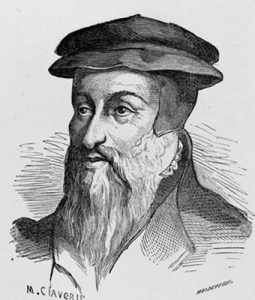
Henri Estienne, alias Henricus Stephanus, was son of the famous Parisian printer Robert Estienne (pictured above) and himself a famous printer. In his 1551 edition of the New Testament he invented the verse divisions which are still used, and present-day scholars citing Plato, Aristotle and other authors still refer to his page numbers. He was fluent in both Greek and Latin, and a first-rate classical scholar. His splendid edition of Thucydides (1564, 2nd ed. 1588) had as preface this charming little poem:
ΕΡΡΙΚΟΥ ΤΟΥ ΣΤΕΦΑΝΟΥ ΕΙΣ ΘΟΥΚΥΔΙΔΗΝ
Ὦ ξένε, εἰ μύθων πολυδαίδαλα ψεύδεα δίζῃ,
Τῶνδ’ ἐγὼ οὐδὲν ἔχω · ἐς χέρα μή με λάβε.
Εἰ μαλακοῖς φθόγγοισι τεαὶ χαίρoυσιν ἀκουαὶ,
Οὐδὲν ἐμοὶ καὶ σοί · ἐς χέρα μή με λάβε.
Σύντομον εἰ ῥῆσιν στυγέεις, ξένε, καινοπρεπῆ τε,
Πᾶν τε τὸ δισξύνετον · ἐς χέρα μή με λάβε.
Εἰ δέ σε ἱστορίης παναληθέος ἵμερος αἱρῇ,
Γράμμα τὸ Θουκυδίδου ἐς χέρα, ξεῖνε, λάβε.
Εἰ σὺ βαρυφθόγγου τέρπῃ σάλπιγγος ἀϋτῇ,
Σαλπίζοντι ἔοικ’ · ἐς χέρα, ξεῖνε, λάβε.
Σύντομον εἰ φιλέεις λόγου ἀτραπὸν ἠδ’ ἀπάτητον,
Κᾄν που ἔῃ χαλεπή · ἐς χέρα, ξεῖνε, λάβε.
Guest, if you covet ornate lies of stories,
for you I’ve nothing: do not pick me up.
Or if your ears delight in pretty voices,
I again have nothing: do not pick me up.
If you dislike terse utterance, the new-fashioned,
the twice-intelligent, do not pick me up.
But if you thirst for accurate history,
then pick up, Guest, this by Thucydides!
If you delight in the deep-wailing war-horn,
like a horn-player, Stranger, pick me up:
or love a terse, untrodden, sometimes hard
pathway of speech, O Stranger, open me.
* * *
* * *
Jacob Balde(1604-1668)
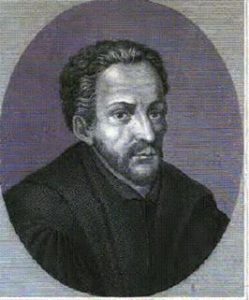
Jacob Balde was a German Jesuit priest and one of the greatest, if not the very greatest, of all Neo-Latin poets. For some years he was also a professor of rhetoric and history; and the poem which I here translate plunges one in thought about the nature of the study of history. For more about him, for the beautiful Latin original, and for notes to it, see http://udallasclassics.org/maurer_files/Balde.pdf .
To a Collector of Roman Coins
To the most illustrious Count Philipp Curtz.
When he showed the author his ancient coin collection
Whenever from beneath Achaean sod
the worn-out metal of a dug-up Caesar
clinks and a squalid coin
is ripped from Roman tombs
you prize it over treasure of our country;
a pleasure sweeter than a jewel, a tyrant
incised into minute
faces of the old metal.
“That’s just how Nero looked, with swollen eyes,”
you say. “That’s Hadrian. That’s the father, Aelius.
Or “See? — the predacessors
of Titus, whom Jewry feared!
“That bull with horns betokens Julian;
the axes, Phocas. Yes, what fine barbarian
disdain and his cruel spirit:
frozen in gold!” What pleasure
to gaze at mildewed brands of cruelty,
at the brows bound with laurel, at the wild
hair bright with stars, state robe,
the sceptre with the bird
flying above it. “Look! at the four-horsed
race-car: its driver, Nerva, into ether
sublimely sends his triumph!
Himself vermilion-faced
directs the robust quarrels of the plebs,
as Rome looks on. How grim, how bristling
that depressed Dacian! Destined
for death before Jove’s altar.”
For a gaze avid for these images,
Philipp, you went in detail over all.
I marvelled at cut emblems
and at the faces broken
with ancient fear: but oh, still more at you,
from whom I thought I heard Boethius’ voice,
the Gracchi, quaint old Cato,
the consuls Fabii,
each in his own old words: and nothing sweeter
did I desire. In your one heart the whole
of lost Time reemerges,
and mocks our histories!
Fearful to later years, into the Senate
you bring a soul resounding with good gods,
live Effigy of Scaurus
or of great Thraseas.
For your bright kindness and the copiousness
of your distinguished mind are a pure lightning
breaking through any cloud
by wits and the quick arrow
of an acuteness! Penetratingly
you can with Delphic thumb palpate the future
and skilled at guessing truth
enjoy a locked-up light.
* * *
* * *
Fyodor Tyutchev (1803-1873)
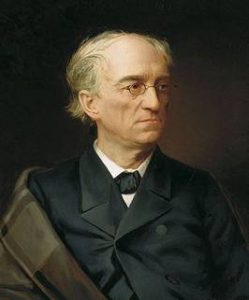
Cicero is a kind of test for students of ancient Rome. Some love him; some, like the great Mommsen, scorn him; many condescend to him, as if, equipped with 20-20 hindsight, they were more intelligent than he. It is curious that this most penetrating, most beautiful of all tributes to him is by a Russian poet. Perhaps Tyutchev in 1838 could already sense the Revolution coming. By ‘the All-benificent’ in line 11 he means, I suppose, the angels. Translation by Karl Maurer.
Цицерон
Оратор римский говорил
Средь бурь гражданских и тревоги:
“Я поздно встал – и на дороге
Настигнут ночью Рима был!”
Так! но, прощаясь с римской славой,
С капитолийской высоты
Во всем величье видел ты
Закат звезды ее кровавой!..
Счастлив, кто посетил сей мир
В его минуты роковые!
Его призвали всеблагие
Как собеседника на пир.
Он их высоких зрелищ зритель,
Ни в их совет допущен был –
И заживо как небожитель
Из чаши их бессмертье пил!
CICERO
The Roman orator spoke
amid civil storms and fear.
“I woke up late and on the road
the night of Rome overtook me.”
True! But saying goodbye to Roman glory
From the Capitoline height
you saw in all its grandeur
the sunset of its bloody star.
Happy is he who visited this world
in its fate-heavy moments.
Him the All-beneficent have invited
to be an interlocutor at their feast.
Spectator of their high spectacles,
admitted into their council,
an inmate of Heaven while alive,
from their cups he has drunk immortality.
1838
* * *
* * *
Alfred Tennyson(1809-1892)
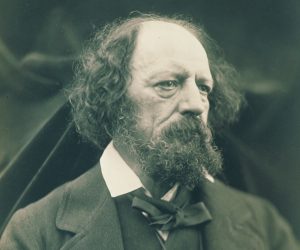
To Virgil
(Written at the request of the Mantuans for the 19th centenary of the poet’s death)
Roman Virgil, thou that singest
Ilion’s lofty temples robed in fire,
Ilion falling, Rome arising,
wars, and filial faith, and Dido’s pyre;
Landscape-lover, lord of language
more than he that sang the Works and Days,
All the chosen coin of fancy
flashing out from many a golden phrase,
Thou that singest wheat and woodland,
tilth and vineyard, hive and horse and herd,
All the charm of all the Muses
often flowering in a lonely word;
Poet of the happy Tityrus
piping underneath his beechen bowers,
Poet of the poet-satyr
whom the laughing shepherd bound with flowers;
Chanter of the Pollio, glorying
in the blissful years again to be,
Summers of the snakeless meadow,
unlaborious earth and oarless sea;
Thou that seest Universal
Nature moved by Universal Mind;
Thou majestic in thy sadness
at the doubtful doom of human kind;
Light among the vanish’d ages;
star that gildest yet this phantom shore;
Golden branch amid the shadows,
kings and realms that pass to rise no more;
Now thy Forum roars no longer,
fallen every purple Caesar’s dome —
Tho’ thine ocean-roll of rhythm
sound for ever of Imperial Rome —
Now the Rome of slaves hath perish’d,
and the Rome of freemen holds her place,
I, from out the Northern Island
sunder’d once from all the human race,
I salute thee, Mantovano,
I that loved thee since my day began,
Wielder of the stateliest measure
ever moulded by the lips of man.
* * *
NOTES to Tennyson. The 1st stanza refers to the Aeneid; the 2nd and 3rd to the Georgics (there “he that sang the Works and Days” is Hesiod); the 4th and 5th to the Eclogues (“Tityrus” etc. = Ecl. 1, “Poet-Satyr” etc. = Ecl. 6, “Pollio” etc. = Ecl. 4). In the 3rd-from-last stanza, “purple Caesar” refers to the ‘toga praetexta’ with its purple border, and to the purple robes worn at triumphs; and “dome” not only to modern Rome: imperial Rome, too, was full of domes, e.g. the Pantheon.
Why is the last line so piercingly beautiful? Because it catches both of two things: ‘stateliest measure’ Vergil’s music, and ‘wielder’ and ‘moulded by the lips’ his living speech. Academics, less astute, tend to imagine that Vergil produced his verse as cerebrally as they do their papers; but he wrote with his hearing. There is a lovely ancient anecdote to this effect, which seems authentic, in Donatus’ Vita Vergiliana, ch. 22: ‘It is said that when he wrote the Georgics, his habit was to dictate very many verses which he had pondered in the morning, and in revising them throughout the day, to reduce them to a very small number, saying wittily that he give birth to his poem as a mother bear did, that he shaped it just by licking it(ursae more… et lambendo demum effingere).’
* * *
* * *
Matthew Arnold(1822-1888)
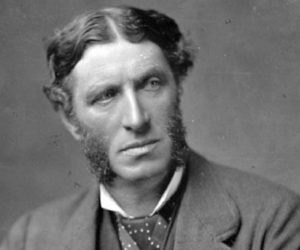
“Apollo Musagetes”
(from “Empedocles in Etna,” 1852).
Through the black, rushing smoke-bursts,
Thick breaks the red flame;
All Etna heaves fiercely
Her forest-clothed frame.
Not here, O Apollo!
Are haunts meet for thee.
But, where Helicon breaks down
In cliff to the sea,
Where the moon-silver’d inlets
Send far their light voice
Up the still vale of Thisbe,
O speed, and rejoice!
On the sward at the cliff-top
Lie strewn the white flocks,
On the cliff-side the pigeons
Roost deep in the rocks.
In the moonlight the shepherds,
Soft lull’d by the rills,
Lie wrapped in their blankets
Asleep on the hills.
–What forms are these coming
So white through the gloom?
What garments out-glistening
The gold-flower’d broom?
What sweet-breathing presence
Out-perfumes the thyme?
What voices enrapture
The night’s balmy prime?
‘Tis Apollo comes leading
His choir, the Nine.
–The leader is fairest,
But all are divine.
They are lost in the hollows!
They stream up again!
What seeks on this mountain
The glorified train?
–They bathe on this mountain,
In the spring by their road;
Then on to Olympus,
Their endless abode.
–Whose praise do they mention?
Of what is it told?
–What will be for ever;
What was from of old.
First hymn they the Father
Of all things; and then,
The rest of immortals,
The action of men.
The day in his hotness,
The strife with the palm;
The night in her silence,
The stars in their calm.
* * *
* * *
Thomas Hardy(1840-1928)
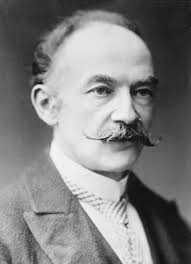
IN THE BRITISH MUSEUM
‘What do you see in that time-touched stone,
When nothing is there
But ashen blankness, although you give it
A rigid stare?
‘You look not quite as if you saw,
But as if you heard,
Parting your lips, and treading softly
As mouse or bird.
‘It is only the base of a pillar, they’ll tell you,
That came to us
From a far old hill men used to name
Areopagus.’
— ‘I know no art, and I only view
A stone from a wall,
But I am thinking that stone has echoed
The voice of Paul,
‘Paul as he stood and preached beside it
Facing the crowd,
A small gaunt figure with wasted features,
Calling out loud
‘Words that in all their intimate accents
Pattered upon
That marble front, and were far reflected,
And then were gone.
‘I’m a labouring man, and know but little,
Or nothing at all;
But I can’t help thinking that stone once echoed
The voice of Paul.’
* * *
* * *
Osip Mandelstam (1891-1938)
Osip Mandelstam (1891-1938) was the greatest Russian poet of the 20th century. He knew Greek and Latin verse intimately; allof his own radiant verse is steeped in it. Here the first two poems were translated by Karl Maurer & ‘Tortoise’ by Bruce McClelland. For another beautiful classical poem by M. see http://udallasclassics.org/maurer_files/SlateOde.pdf.
Nature resembles Rome and is the same as Rome.
We see signs of her civic might and her decorum
In the blue Circus of the sky’s transparent dome,
The groves of colonnades, the meadow of the Forum.
Nature resembles Rome; so that now, as before,
There is no need to importune the gods. We hold
Entrails of victims wherein to divine of war;
Slaves to keep silent; heavy stones with which to build.
1914
* * *
When in dark of the night falls silent
The feverish forum of Moscow
And the theatres’ jaws flung open
Return crowds into the squares
There flows through its sumptuous streets
Hubbub of a wake held at midnight
And mourning revellers throng
As if from some divine womb.
It is only the rabble, excited by the Games,
Come to bury the nocturnal sun,
From their midnight feasts returning
To the muffled thudding of hooves.
And like a new Herculaneum arisen
Sleeps the city in the light of the moon,
The hovels of its wretched market,
Its mighty Doric stems.
Moscow, May 1918 (#102)
* * *
TORTOISE
On the stony spurs of Pieria
The Muses conducted the first round dance
So like bees, blind lyrists
Might give us Ionic honey.
A great chill blew
From the prominent virginal brow
So that distant grandsons might open
The Archipelago’s tender graves.
Spring rushes, tramples the meadows of Hellas,
Sappho puts on a dappled boot,
Cicadas, little smiths, click and hammer
Forging a ring, as in the little song.
A stout carpenter built a tall house,
They strangled all the hens for a wedding,
An inept cobbler stretched
All five ox-hides for shoes.
The sluggish lyre-tortoise
Toeless barely creeps along,
Sets herself down in the sun of Epirus
Quietly warming her golden belly.
Who will caress someone like her,
Who will turn her over while she sleeps
She awaits Terpander in her dream,
Sensing the sudden sweep of dry fingers.
A cold sprinkle waters the oaks,
The bareheaded grasses murmur,
The honeysuckle smells, to the joy of the bees.
O where are you, sacred islands,
Where they do not eat broken bread,
Where there is only wine, milk and honey,
Creaking toil does not darken the sky, and
The wheel turns easily?
1919
* * *
* * *
Louis MacNeice(1907-1963)
On the ancient Greeks
Louis MacNeice went to Marlborough and to Merton College, Oxford where he got a first in Literae Humaniores; he lectured in Classics, alongside E. R. Dodds, at the University of Birmingham (1930-1936) and in Greek at the University of London (1936-1939). This is from “Autumn Journal” (1939) Part IX. From the last lines it’s obvious that he had had enough, at least for the time being, of teaching Classics, and he did give it up a few months later. (Those last lines subvert my overall purpose in these pages, of praising the study of classics! But most classicists do know that mood; and the whole poem is so full of charm that I cannot bear to omit it, or truncate it.)
October comes with rain whipping around the ankles
In waves of white at night
And filling the raw clay trenches (the parks of London
Are a nasty sight).
In a week I return to work, lecturing, coaching,
As impresario of the Ancient Greeks
Who wore the chiton and lived on fish and olives
And talked philosophy or smut in cliques;
Who believed in youth and did not gloze the unpleasant
Consequences of age;
What is life, one said, or what is pleasant
Once you have turned the page
Of love? The days grow worse, the dice are loaded
Against the living man who pays in tears for breath;
Never to be born was the best, call no man happy
This side death.
Conscious — long before Engels — of necessity
And therein free
They plotted out their life with truism and humour
Between the jealous heaven and the callous sea.
And Pindar sang the garland of wild olive
And Alcibiades lived from hand to mouth
Double-crossing Athens, Persia, Sparta,
And many died in the city of plague, and many of drouth
In Sicilian quarries, and many by the spear and arrow
And many more who told their lies too late
Caught in the eternal factions and reactions
Of the city-state.
And free speech shivered on the pikes of Macedonia
And later on the swords of Rome
And Athens became a mere university city
And the goddess born of the foam
Became the kept hetæra, heroine of Menander,
And the philosopher narrowed his focus, confined
His efforts to putting his own soul in order
And keeping a quiet mind.
And for a thousand years they went on talking,
Making such apt remarks,
A race no longer of heroes but of professors
And crooked business men and secretaries and clerks,
Who turned out dapper little elegiac verses
On the ironies of fate, the transience of all
Affections, carefully shunning an over-statement
But working the dying fall.
The Glory that was Greece: put it in a syllabus, grade it
Page by page
To train the mind or even to point a moral
For the present age:
Models of logic and lucidity, dignity, sanity,
The golden mean between opposing ills
Though there were exceptions of course but only exceptions
The bloody Bacchanals on the Thracian hills.
So the humanist in his room with Jacobean panels
Chewing his pipe and looking on a lazy quad
Chops the Ancient World to turn a sermon
To the greater glory of God.
But I can do nothing so useful or so simple;
These dead are dead
And when I should remember the paragons of Hellas
I think instead
Of the crooks, the adventurers, the opportunists,
The careless athletes and the fancy boys,
The hair-splitters, the pedants, the hard-boiled sceptics
And the Agora and the noise
Of the demagogues and the quacks; and the women pouring
Libations over graves
And the trimmers at Delphi and the dummies at Sparta and lastly
I think of the slaves.
And how one can imagine oneself among them
I do not know;
It was all so unimaginably different
And all so long ago.
* * *
* * *
Czeslaw Milosz(1911-2004)
READINGS
You asked me what is the good of reading the Gospels in Greek.
I answer that it is proper that we move our finger
Along letters more enduring than those carved in stone,
And that, slowly pronouncing each syllable,
We discover the true dignity of speech.
Compelled to be attentive we shall think of that epoch
No more distant than yesterday, though the heads of caesars
On coins are different today. Yet still it is the same eon.
Fear and desire are the same, oil and wine
And bread mean the same. So does the fickleness of the throng
Avid for miracles as in the past. Even mores,
Wedding festivities, drugs, laments for the dead
Only seem to differ. Then, too, for example,
There were plenty of persons whom the text calls
δαιμονιζὀμενοι, that is, the demonized
Or, if you prefer, the bedeviled (as for “the possessed”
It’s no more than the whim of a dictionary).
Convulsions, foam at the mouth, the gnashing of teeth
Were not considered signs of talent.
The demonized had no access to print and screens,
Rarely engaging in arts and literature.
But the Gospel parable remains in force:
That the spirit mastering them may enter swine,
Which, exasperated by such a sudden clash
Between two natures, theirs and the Luciferic,
Jump into water and drown (which occurs repeatedly).
And thus on every page a persistent reader
Sees twenty centuries as twenty days
In a world which one day will come to an end.
(Translated by Milosz and Robert Haas)
* * *
from A Treatise on Poetry:
From broken armor, from eyes stricken
By the command of time and taken back
Into the jurisdiction of mold and fermentation,
We draw our hope. Yes, to gather in an image
The furriness of the beaver, the smell of rushes,
And the wrinkles of a hand holding a pitcher
From which wine trickles. Why cry out
That a sense of history destroys our substance
If it, precisely, is offered to our powers,
A muse of our gray-haired father, Herodotus,
As our arm and our instrument, though
It is not easy to use it, to strengthen it
So that, like a plumb with a pure gold center,
It will serve again to rescue human beings.
(Translated by Milosz and Robert Haas)
* * *
* * *
Lawrence Durrell(1912-1990)
NEMEA
A song in the valley of Nemea.
Sing quiet here, quite quiet.
Song for the brides of Argos
Combing the swarms of golden hair:
Quite quiet, quiet there.
Under the rolling comb of grass
The sword rusts, not the golden helm.
Agammemnon calm beneath his tumulus
Outsmiles the jury of skeletons.
The lion queen cool under cumulus
Only the adjective can outlive,
Nothing celebrate but the drum.
A song in the valley of Nemea:
Sing quiet, quiet, quiet here.
The frog’s tone in the empty well,
The bald bee droning on the skull
Are quiet, quite quiet.
DELOS
On charts they fall like lace,
Islands consuming in a sea
Born dense with its own blue,
And like repairing mirrors holding up
Small towns and trees and rivers
To the still air, the lovely air
They spring from the clear side of springing Time
In clement places where the windmills ride,
Turning over grey springs in Mykonos
In shadows with a gesture of content.
The statues of the dead here
Embark on sunlight sealed
Each in her model with the sightless eyes,
The modest stones of Greeks,
Who gravely interrupted death by pleasure.
And in harbours softly fallen
The liver-coloured sails.
Sharp-featured brigantines with eyes
Ride in reception (so like women–
The pathetic faculty of girls
To register and utter a desire)
And in men’s arms upon the new-mown waters
Follow the wind with their long shining keels
Aimed across Delos at a star.
* * *
* * *
Zbigniew Herbert(1924-1998)
Why The Classics
I
In the fourth book of the Peloponnesian War
Thucydides tells among other things
the story of his unsuccessful expedition.
Among long speeches of chiefs
battles sieges plague
dense net of intrigues of diplomatic endeavors
the episode is like a pin
in a forest
the Greek colony Amphipolis
fell into the hands of Brasidos
because Thucydides was late with relief
for this he paid his native city
with lifelong exile
exiles of all times
know what price that is
II
generals of the most recent wars
if a similar affair happens to them
whine on their knees before posterity
praise their heroism and innocence
they accuse their subordinates
envious colleagues
unfavourable winds
Thucydides says only
that he had seven ships
it was winter
and he sailed quickly
III
if art for its subject
will have a broken jar
a small broken soul
with a great self-pity
what will remain after us
will be like lovers’ weeping
in a small dirty hotel
when wall-paper dawns
(Translated from the Polish by Czeslaw Milosz)
* * *
* * *
MISC. TESTIMONIALS TO THE VALUE OF CLASSICS
(Most of these are from the Haverford College classics website)
“But I have never gone away from them. How can an educated person stay away from the Greeks? I have always been far more interested in them than in science.” —Albert Einstein
“All the more strange, then, is it that we should wish to know Greek, try to know Greek, feel for ever drawn back to Greek, and be forever making up some notion of the meaning of Greek, though from what incongruous odds and ends, with what slight resemblance to the real meaning of Greek, who shall say?” — Virginia Woolf
“I would make them all learn English: and then I would let the clever ones learn Latin as an honor, and Greek as a Treat.” — Sir Winston Churchill
“It took Latin to thrust me into bona fide alliance with words in their true meaning. Learning Latin…fed my love for words upon words, words in continuation and modification, and the beautiful accretion of a sentence….” — Eudora Welty
“It allows you to adore words, take them apart and find out where they came from.” — Theodore Geisel (Dr. Seuss)
“I continue to keep myself busy with Greek and Latin, and perhaps I’ll always keep myself busy with them. I love the perfume of those beautiful languages; Tacitus is for me like bronze bas-reliefs, and Homer is beautiful like the Mediterranean: both have the same pure blue waves, the same sun, and the same horizon.” — Gustave Flaubert
“We are all Greeks! Our laws, our literature, our art, have their roots in Greece.” — Percy Bysshe Shelley
“One of the regrets of my life is that I did not study Latin. I’m absolutely convinced, the more I understand these eighteenth-century people, that it was that grounding in Greek and Latin that gave them their sense of the classic virtues: the classic ideals of honor, virtue, the good society and their historic examples of what they could try to live up to.” — David McCullough, Historian and author
“To read the Latin and Greek authors in their original is a sublime luxury…I thank on my knees him who directed my early education for having in my possession this rich source of delight.” —Thomas Jefferson to Dr. Joseph Priestly January 27, 1800
“I think myself more indebted to my father for this than for all the other luxuries his cares and affections placed within my reach.” — Thomas Jefferson, on his classical education.
* * *
* * *
NATIONAL TEST SCORES OF CLASSICS STUDENTS
The GRE examinations are taken by college seniors bound for graduate school. The results, tabulated by intended field of study, reflect what the test-takers majored in as undergraduates. Out of all 270 fields of study the best Verbal scores belong to Classical Languages. I here give the data, taken from the PDF files at ets.org, for two different time periods, 2005-2008 and 1999-2002:
THE 12 FIELDS WHOSE STUDENTS SCORED HIGHEST MEAN “VERBAL” GRE:
Students tested between 1 July 2005 and 30 June 2008
| INTENDED GRADUATE MAJOR | Verbal | Quantitative |
combined
|
Analytical
Writing |
| Classical Languages | 619 | 633 | 1252 | 4.8 |
| Classics | 609 | 616 | 1225 | 4.7 |
| History of Science | 596 | 661 | 1257 | 4.9 |
| All philosophical fields | 591 | 630 | 1221 | 4.9 |
| Comp. Language & Lit. | 591 | 588 | 1179 | 4.8 |
| Russian | 584 | 611 | 1195 | 4.7 |
| English Lang. & Lit | 567 | 547 | 1114 | 4.7 |
| Psycholinguist | 566 | 636 | 1202 | 4.6 |
| Linguistics | 566 | 630 | 1196 | 4.6 |
| Foreign Lit. | 566 | 580 | 1146 | 4.5 |
| American Language & Literature | 566 | 552 | 1118 | 4.7 |
| Religious Studies | 558 | 545 | 1103 | 4.7 |
Students tested between 1 July 1999 and 30 June 2002.
| INTENDED GRADUATE MAJOR | Verbal | Quantitative | Analytical | combined |
| Classical Languages | 613 | 622 | 643 | 1878 |
| History of Science | 610 | 667 | 679 | 1956 |
| Classics | 607 | 595 | 647 | 1849 |
| Semitic Languages | 588 | 621 | 655 | 1864 |
| All philosophical fields | 586 | 626 | 644 | 1856 |
| Comp. Language & Lit. | 577 | 580 | 613 | 1770 |
| Russian | 573 | 583 | 619 | 1775 |
| Foreign Literature | 565 | 589 | 592 | 1746 |
| American Language & Literature | 559 | 556 | 608 | 1723 |
| Religion | 558 | 574 | 620 | 1752 |
| European History | 557 | 559 | 619 | 1735 |
| Creative writing | 552 | 535 | 596 | 1683 |
Similar is the data for the SAT college entrance exams, plotted against eventual choice of language majors. The first table below (for 2002-2009) was made by Patricia Rawlins, president of the Texas Classical Association and Chair of Latin at SMU, using stats from two College Board reports: “College-Bound Seniors — A Profile of SAT Program Test Takers”, Table 6, and “2010 College-Bound Seniors–Total Group Profile Report.” The second table (for 1996-2002) is from a page at Creighton University: http://puffin.creighton.edu/clc/Student_page/Careers.html#Law.
| 2002 | 2003 | 2004 | 2005 | 2006 | 2007 | 2008 | 2009 | ||||||||
| Latin | 666 | 672 | 674 | 681 | 672 | 678 | 677 | 676 | |||||||
| All Students | 504 | 507 | 508 | 508 | 503 | 502 | 502 | 502 | |||||||
| French | 637 | 638 | 642 | 643 | 637 | 637 | 632 | 631 | |||||||
| German | 622 | 626 | 627 | 637 | 632 | 632 | 627 | 630 | |||||||
| Spanish | 581 | 575 | 575 | 573 | 577 | 574 | 565 | 557 | |||||||
| Hebrew | 629 | 628 | 630 | 620 | 623 | 622 | 611 | 619 |
| 1996 | 1997 | 1998 | 1999 | 2000 | 2001 | 2002 | |
| Latin | 648 | 647 | 654 | 662 | 665 | 665 | 666 |
| All students | 504 | 505 | 505 | 505 | 505 | 506 | 504 |
| French | 625 | 623 | 627 | 632 | 636 | 633 | 637 |
| German | 625 | 624 | 617 | 623 | 621 | 625 | 622 |
| Spanish | 576 | 581 | 583 | 590 | 589 | 583 | 581 |
| Hebrew | 622 | 629 | 634 | 636 | 623 | 628 | 629 |
The MCAT is the single most frightening and difficult hurdle for prospective medical professionals. Classics Majors can therefore take comfort from the following statistics collected on the 1997 applicants to allopathic (MD) medical schools in North America tabulated by acceptance rate to medical school and sub-tabulated alphabetically by major. Notice that here the Classics major not only excels all majors in Verbal Reasoning, but also excels the Chemistry major in Biological Sciences, and excels the Biology major both in Biological and in Physical Sciences!! (Data collected by Prof. Charles Austerberry, of Creighton University, Department of Biology. For more on Classics and medical school, see above, item 13.) —
| MAJOR | Total number of applicants | Number and percent accepted | Average MCAT score Verbal Reasoning |
Average MCAT score Physical Sciences |
Avg. MCAT score Biological Sciences |
| Classics | 54 | 27 (50%) | 10.0 | 9.2 | 9.4 |
| Economics | 436 | 205 (47%) | 9.5 | 9.7 | 9.7 |
| History | 522 | 243 (47%) | 9.9 | 9.1 | 9.4 |
| Poly Sci | 320 | 150 (47%) | 9.7 | 8.9 | 9.2 |
| Religion | 120 | 56 (47%) | 9.7 | 9.0 | 9.3 |
| English | 613 | 275 (45%) | 9.8 | 8.9 | 9.1 |
| Chemistry | 2505 | 1057 (42%) | 8.4 | 9.3 | 9.0 |
| Art | 95 | 38 (40%) | 9.2 | 8.8 | 9.2 |
| Biology | 16337 | 6219 (38%) | 8.4 | 8.4 | 9.0 |
| Psychology | 2196 | 845 (38%) | 8.9 | 8.3 | 8.6 |
| Education | 85 | 17 (20%) | 8.0 | 7.5 | 7.8 |